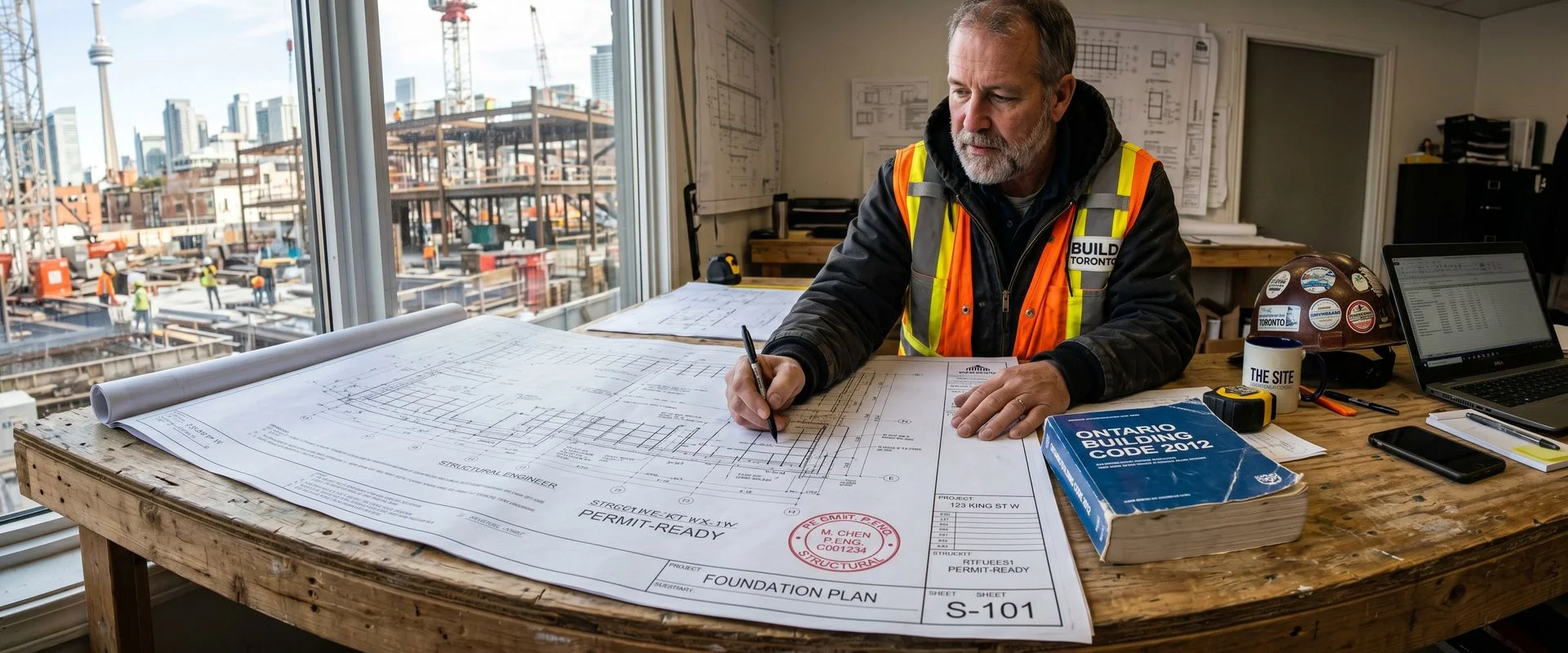
Drawings & Building Permits Stop More Projects Than Budget Does
Have you ever wondered what actually holds up a major basement renovation? It is rarely a lack of funds or finding the right contractor. Getting your drawings & building permits sorted out is the hidden hurdle that catches many Toronto homeowners completely off guard.
Basement underpinning is a serious structural alteration.
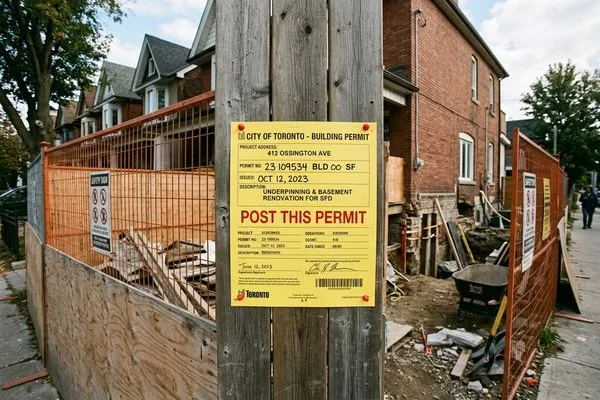
The City of Toronto Building Division strictly requires a building permit and professionally engineered drawings for every project. Skipping this step leads to three massive headaches:
- Voided insurance: Your home insurance immediately voids any claim related to the unpermitted work.
- Unsellable property: The house becomes legally unsellable until the work is permitted retroactively, which usually triggers a penalty where the city doubles your permit fees.
- Stop-Work Orders: An inspector will issue a formal Stop-Work Order under the Building Code Act the moment they notice unauthorized digging.
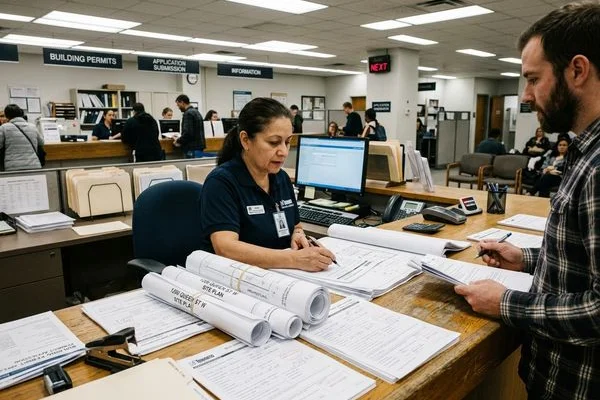
Our scope handles the entire administrative pipeline for you. This includes managing the architect, structural engineer, and the complete City of Toronto submission. We also take care of the plan review, Committee of Adjustment hearings, and inspection scheduling during construction.
What’s In The Permit Package
Getting your application approved quickly comes down to giving the city exactly what they want on the very first try. The Toronto Building Division has strict criteria for structural modifications.
Our team assembles a comprehensive package to prevent unnecessary delays. You simply sign the final application as the property owner, and that is the only municipal paperwork you ever have to touch.
Every Toronto underpinning permit application includes a specific set of required documents:
- Architectural site plan: This shows property lines, existing structures, and any proposed changes.
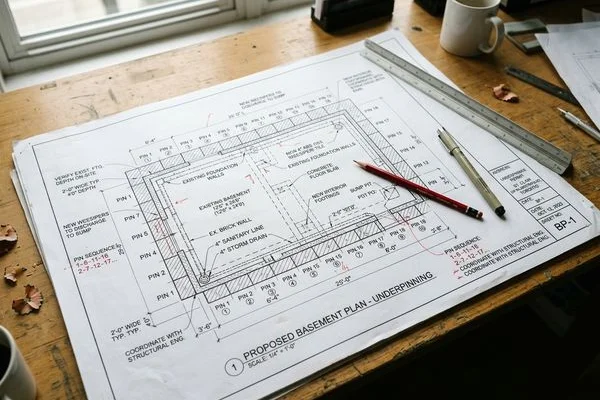
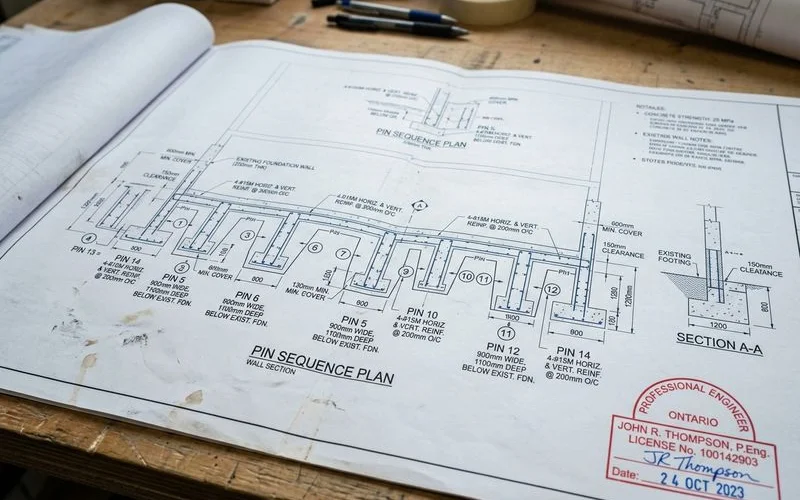
- Foundation plan: We detail existing and new footing locations, depths, and exact dimensions.
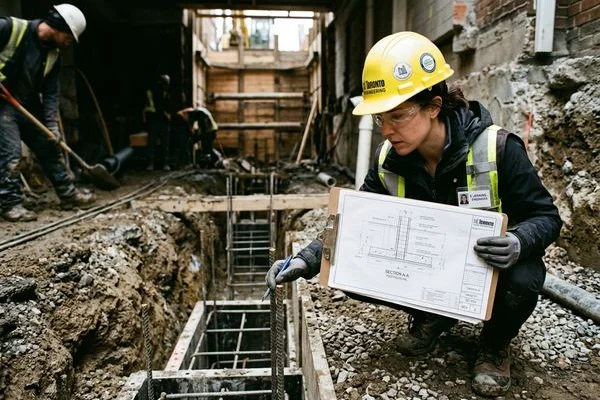
- Section drawings: These provide a visual cross-section of the specific underpinning method.
- Structural engineering report: This includes footing capacity calculations, pin sequencing, and reinforcement schedules.
- Engineer’s seal: Every structural drawing must be stamped by an Ontario-licensed structural engineer.
- Soils report: Geotechnical soil testing is required when specified by the plan reviewer or due to unique site conditions.
- Completed City of Toronto application forms: All necessary documents are fully prepared for your signature.
Additional Clearances You Might Need
Some properties require extra approvals before the building permit is even reviewed. A Zoning Applicable Law Certificate (ZAP) is often required to prove your plans align with local bylaws.
If your property sits within a conservation overlay, you will need Toronto and Region Conservation Authority (TRCA) approval. TRCA reviews typically take 21 days for minor applications.
You might also need a Heritage permit application when the property is located in a Heritage Conservation District.
Committee of Adjustment Representation
The Committee of Adjustment (CoA) handles minor zoning variance requests. These are situations where your proposed project does not perfectly fit standard zoning bylaws.
Even with a high historical approval rate in many Toronto districts, a CoA hearing adds a minimum of two to four months to your project timeline. For basement underpinning, a variance request commonly applies in several scenarios.
- Adding a new exterior entrance changes the building’s established setback or overall footprint.
- The property’s lot coverage or floor space ratio approaches the maximum zoning limit.
- The new basement use requires a use variance under the zoning bylaw, like creating a legal apartment.
- A property with a heritage overlay needs relief from specific heritage attributes.
Our project manager attends these hearings as your designated agent. As of 2026, the City of Toronto charges a minor variance fee of $2,228.98 for residential dwellings with three units or less. You do not need to take a day off work to appear, because we manage the entire presentation and defense of your design.
Heritage Conservation Districts
Several Toronto neighbourhoods proudly feature Heritage Conservation Districts (HCD). The Annex, Cabbagetown, parts of the Junction, Riverdale, Wychwood, and Old Oakville are well-known examples.
The HCD designation primarily restricts visible exterior changes. Interior underpinning is not directly restricted, but any external excavation or window-well change will trigger a heritage permit alongside your standard building permit.
We screen your property for HCD designation during our very first site visit. According to the City of Toronto Heritage Permit Guide, the city legally has up to 90 days to issue a decision on a complete heritage application.
Simple staff-level approvals can sometimes take just a week, but our team always builds the official timeline into your project schedule.
Permit Process Across The GTA
Permit processing times and fees vary widely depending on which municipal building department you are dealing with. The City of Toronto offers an Express Services stream for simple interior renovations, but structural underpinning always requires a full standard review.
Our experience across the Greater Toronto Area allows us to set realistic expectations from day one. Spring is historically the busiest filing period, which often pushes review times to the maximum limit.
The table below outlines standard timelines and estimated fees across different municipalities. These fees are based on municipal guidelines and are subject to annual updates.
| Municipality | Plan Review | Permit Fee Range |
|---|---|---|
| City of Toronto | 4 to 8 weeks | $1,000 to $2,500 |
| City of Mississauga | 3 to 5 weeks | $800 to $2,000 |
| City of Markham | 4 to 6 weeks | $900 to $2,200 |
| City of Vaughan | 5 to 7 weeks | $900 to $2,200 |
| City of Brampton | 4 to 7 weeks | $800 to $2,000 |
| Town of Oakville | 4 to 6 weeks | $1,000 to $2,400 |
| City of Burlington | 5 to 7 weeks | $900 to $2,200 |
| City of Pickering | 4 to 6 weeks | $800 to $2,000 |
Combined With Other Work
Many homeowners choose to combine their structural upgrades with other basement improvements to save time and money. Pulling one comprehensive permit is much more efficient than applying for separate approvals months apart.
Our design team looks for opportunities to consolidate your paperwork. If you are adding a legal second suite, a combined permit will also cover essential fire separation upgrades and plumbing modifications.
- With underpinning: The cost for drawings and permits is neatly folded into your complete project quote.
- With basement finishing: A single, combined permit covers both the heavy structural work and your final finishing scope.
- With foundation repair: Minor crack injection typically does not require a permit, but any engineered footing repair absolutely does.
Tackling your drawings & building permits alongside your main construct