A Vetting Framework, Not A Marketing Pitch
From what I have seen, altering the structural integrity of your home requires a massive leap of faith. The standard for hiring a professional here must be much higher than picking someone to renovate a kitchen. You need to know exactly how to choose basement underpinning contractor toronto options that protect your property.
Our Experience running this work shows that a typical project budget often hits $95,000 to $108,000. That investment makes sense when you consider a legal two-bedroom basement suite currently generates $2,200 to $2,600 per month in rental income. The financial stakes are simply too high for guesswork.
Let’s look at the data and explore a few practical ways to vet your options. If you only read one section, read The Eight Questions further down.
They will tell you within a single phone call which builders are serious.
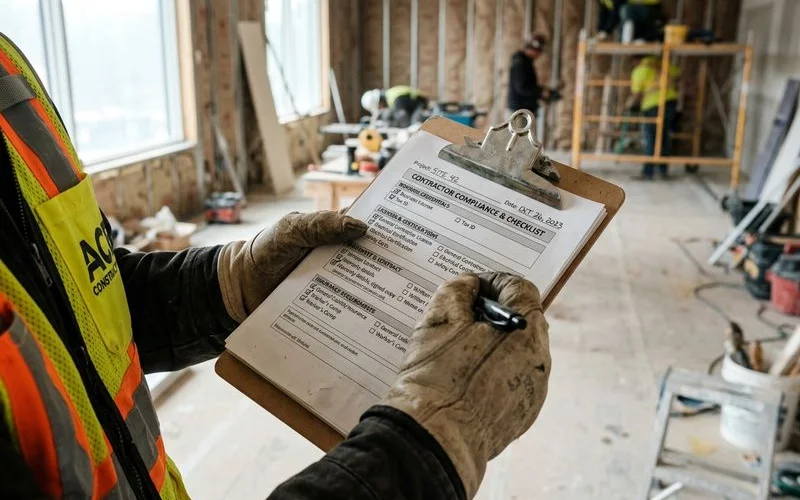
Verification Checklist
Understanding how to choose basement underpinning contractor toronto options is easier with a clear checklist.
License & Insurance
Every legitimate Ontario contractor doing structural work carries three mandatory credentials. You must verify these details before signing any paperwork.
- General contractor licensing for the relevant municipality. Ontario lacks a single provincial licence, so verify this against your specific city of operation.
- WSIB (Workplace Safety & Insurance Board) clearance to protect you from liability for workplace injuries on your property.
- General liability insurance to cover accidental property damage during construction.
Our team insists on reviewing the Certificate of Insurance (COI) before any agreement is signed. WSIB clearances are only valid for up to 90 days. You should always verify the exact expiry date on the official wsib.ca website.
Professional liability coverage through the structural engineer is another critical detail. Professional Engineers Ontario requires a bare minimum of $250,000 per claim. Most complex residential jobs demand $1 million to $2 million limits to properly cover structural risks.
Structural Engineer Involvement
Every Ontario basement underpinning project requires drawings stamped by an Ontario-licensed Professional Engineer with a structural specialty. The question is never if there is an engineer involved, but exactly how they participate in the build.
- In-house relationship (preferred): The contractor works with the same engineer regularly. Drawings reflect the crew’s actual capabilities, and site visits during construction are scheduled in advance.
- Subcontracted per-project (acceptable but slower): The contractor hires a different engineer for each project. This path is workable but introduces communication delays.
- Homeowner-hired (avoidable): The homeowner engages the engineer directly. This creates immense coordination friction.
We work with the same engineering firms project after project. The 2026 Ontario Building Code Section 9 includes strict new mandates, such as sub-floor depressurization rough-ins for radon mitigation. Subcontracted engineers often miss these local updates, while a dedicated partner integrates them immediately.
Project Portfolio Depth
Ask for a portfolio of similar Toronto projects to prove their local competence. The best underpinning contractor toronto residents can hire will know the specific challenges of your street.
- At least 50 underpinning projects in the last decade: This is the volume threshold where a crew develops the staging rhythm that prevents schedule slippage.
- Projects in homes similar to yours: Pre-1920 Victorian semis, post-war bungalows, or brick row houses all require different techniques.
- At least 5 reference projects in your neighbourhood: Familiarity with the local building department and soil profile is invaluable.
Our planners factor in local logistics before a shovel ever hits the ground. For example, working in the Annex means handling heavy clay soil, tight lot access, and strict heritage permit rules. Current Toronto building permit timelines average 6 to 12 weeks for a clean residential submission. A contractor lacking local experience will get stuck in city backlogs for months.
Warranty Terms
Read the fine print on the warranty documentation. Many homeowners mistakenly assume their renovations fall under the Tarion New Home Warranty program. Tarion provides a seven-year structural defect warranty for brand new builds. Typical basement lowering on an older semi-detached house does not qualify for Tarion coverage.
Your contractor’s written warranty is your only structural safety net. Every quote should specify exactly what the warranty applies to.
- What is covered: The document must list footings, structural integrity, and waterproofing if included.
- What is excluded: Water damage from above-grade sources or settlement caused by new tree roots are typically excluded.
- Duration: Most reputable guarantees offer lifetime coverage on structural integrity.
- Resolution mechanism: A written workmanship warranty means the builder returns and resolves the issue directly.
We offer a workmanship warranty to eliminate any ambiguity. Most competitors provide something much narrower. That limited protection is their right, but you must review the contract carefully.
Red Flags vs Green Flags
Comparing options requires a strict underpinning contractor checklist to separate the professionals from the amateurs.
| Red Flag | Green Flag |
|---|---|
| Quote without on-site assessment | Engineered site visit before quoting |
| ”Engineering separate” or “permits TBD” | Drawings + permits bundled in quote |
| Vague pricing (“starting at…”) | Line-item fixed price after engineering |
| Cash-only or off-permit work offered | Fully permitted, properly insured work only |
| ”We can start next week” with no permit on file | Realistic 14 to 24 week project timeline |
| Aggressive sales pressure | Quotes with no expiry pressure, no upselling |
| No structural engineer named | Named Ontario-licensed P.Eng. on the project |
| Few or no references | 50+ similar projects with verifiable references |
| Limited warranty with many exclusions | Workmanship warranty |
| Slow or vague communication during sales | Detailed written responses within 24 hours |
The Eight Questions Every Homeowner Should Ask
These are the questions any experienced property owner should ask during the initial consultation. The answers tell you more about the company than the final quote price ever will.
- Do you do an engineered site visit before quoting, or do you quote off photos? An engineered site visit is the only correct answer.
- Who is the Ontario-licensed structural engineer on this project, and how often do they visit the site? You need a named engineer who visits at multiple inspection points.
- Will you provide a Certificate of Insurance with $2M+ general liability and a WSIB clearance certificate? They must provide this immediately.
- Is the price fixed after the engineered drawings are stamped, or can it change? The price must be fixed, barring homeowner-initiated change orders.
- What is the realistic project timeline from contract signing to slab handover? Expect 14 to 24 weeks for the work alone.
- Have you done at least 5 underpinning projects in my neighbourhood in the last 5 years? They need verifiable references.
- What does your warranty actually cover and how do I trigger a claim? You need a detailed answer in writing.
- Can I see the engineered drawings from a recent similar project? Their willingness to share is a strong positive signal.
What “50 Similar Projects” Actually Means
We have completed many Toronto underpinning projects across every major neighbourhood. A builder who has done one Annex Victorian and one North York bungalow can technically claim to have done similar projects. Familiarity with a specific postal code changes the entire work process.
A contractor who has finished 50 Annex Victorians has internalized the exact soil profile and the staging logistics for narrow lots. This specific expertise cuts 2 to 3 weeks off the schedule and produces fewer mid-project surprises.
- Ask for recent volume: “How many similar projects have you done in the last 12 months?”
- Evaluate current staffing: Twelve-month volume tells you if the crew is actively staffed for this specific work.
- Check price points: The structural work alone for a standard depth increase currently runs $50 to $75 per square foot.
Our project managers understand that historical experience does not guarantee current capacity. You need a team that is actively trenching and pouring concrete right now.
Comparing Quotes Apples-To-Apples
Three quotes from three contractors will rarely match line-by-line on scope. The cheapest quote usually omits crucial elements, while the most expensive one is not always the best value.
Common scope variations include:
- Drawings and permits: Are these included or billed extra? City of Toronto building permit fees run approximately $11.89 per linear metre plus a base fee.
- Waterproofing: Is this an integrated service or a completely separate scope of work?
- Slab restoration finish: Will you receive a rough slab or a finish-ready surface?
- Engineer’s site visits: How many mandatory inspections are actually included in the price?
- Warranty: Is it a clear workmanship warranty or limited with hidden exclusions?
- Timeline: Is the projected schedule realistic or dangerously optimistic?
We advise homeowners to normalize the quotes by asking each bidder to itemize the exact same line items. This forces everyone to use the same boundaries for their pricing.
Ready For The Final Step?
If you have vetted your options and we are on your shortlist, the next step is the engineered site visit.
Our team will bring an Ontario-licensed structural engineer, walk the basement with you, and quote a fixed price within two business hours.
Looking for cost benchmarks before booking?
See our provincial cost guide for the full pricing range across Ontario. Learning how to choose basement underpinning contractor toronto experts is your best defense against an expensive mistake.