We constantly hear from Toronto homeowners that the basement underpinning process feels like a complete mystery.
This confusion usually happens because contractors gloss over the hard science and strict bylaws that dictate the pace of the work.
Our experience shows that the safest, most successful projects follow a highly predictable sequence. Understanding this reality helps you plan your life around the construction and avoid false promises.
The sequence below outlines the actual underpinning timeline. Each phase connects directly to structural requirements or municipal code.
Stage-By-Stage Walkthrough: The Basement Underpinning Process
Most homeowners want a realistic timeline more than they want marketing language. The actual sequence of a Toronto basement underpinning project follows a strict path.
Our 2026 project data reveals realistic durations for each critical stage.
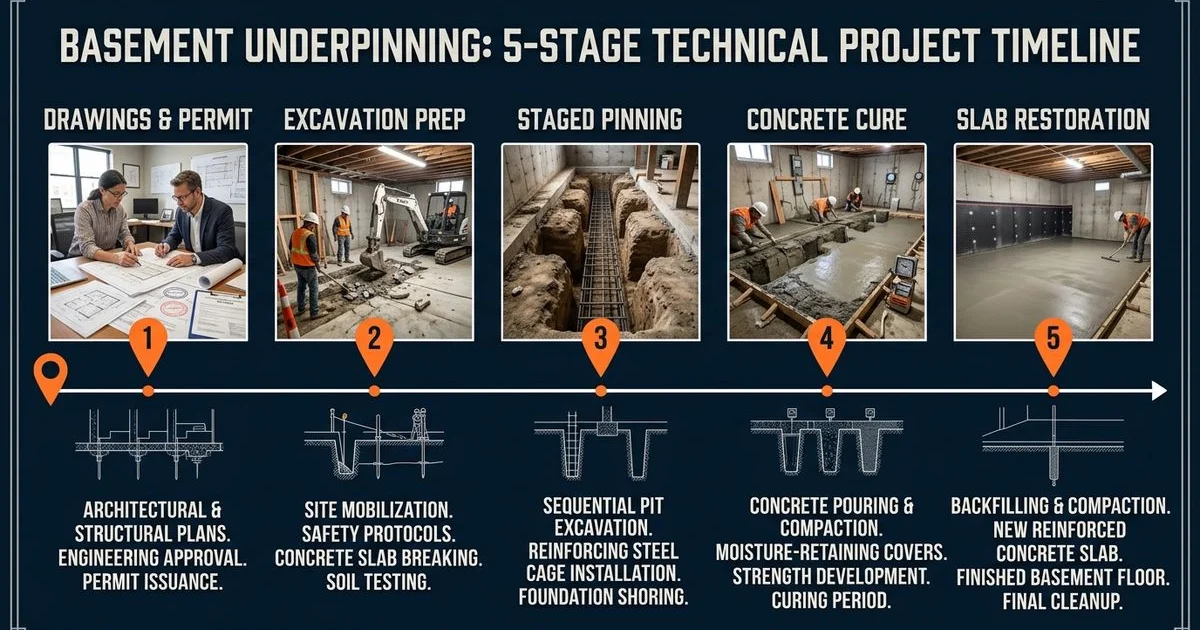
Stage 1: Drawings & Engineering (2 to 4 weeks)
We begin by having a structural engineer calculate exactly how to safely achieve the 24 to 36 inches of new depth without compromising your home.
The architect then produces a detailed site plan and foundation drawings.
Our team coordinates these details to lock in your final layout, including bathroom rough-ins and beam pockets. Under the Ontario Building Code, you need a minimum ceiling height of 6 feet 5 inches (1.95m) to create a legal living space.
Skipping this stage or rushing the design is exactly what causes expensive downstream finishing problems.
The structural engineer develops footing depths, reinforcement details, and the alternating pin-section sequence. Both professionals must stamp the drawings before any paperwork goes to the city. For a deeper look at what goes into the permit package, see our drawings & permits page.
Stage 2: City of Toronto Permit Review (4 to 8 weeks)
Our complete application package goes straight to the City of Toronto Building Department.
As of 2026, all permit packages are submitted digitally through the Toronto Building Online portal.
The plan reviewer checks for code compliance, specifically Ontario Building Code Section 9.13 for the structural underpinning detail. They also review OBC Section 9.36 if a legal apartment is part of the scope.
Our tracking shows that most clean Toronto underpinning permits clear the system in 4 to 8 weeks. A project requiring a Committee of Adjustment hearing for zoning variances will add another 3 to 4 months to your timeline.
Stage 3: Staged Excavation & Pin Pours (4 to 6 weeks)
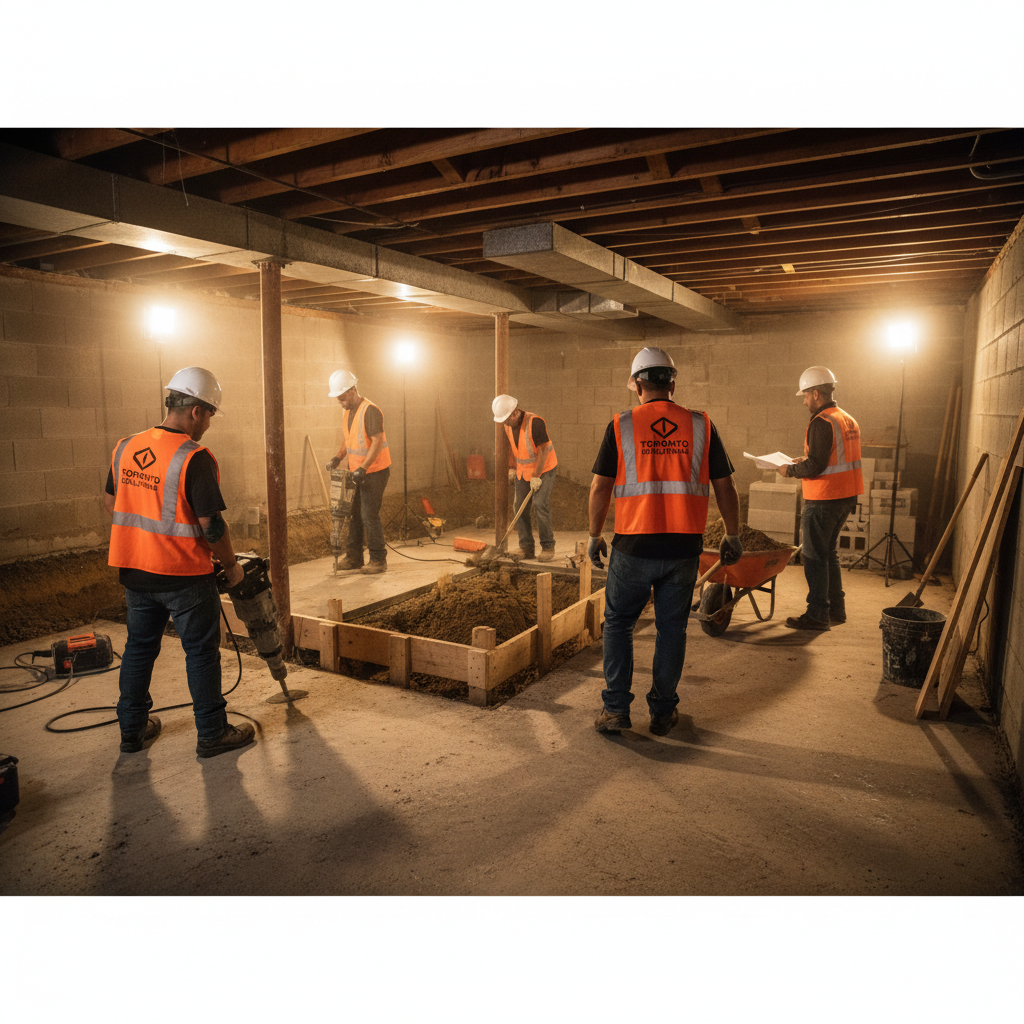
We bring in the excavation crew to set up dust isolation, remove the existing slab, and begin the careful pin sequence.
The crew works in carefully planned 4-to-6-foot sections to maintain absolute structural integrity.
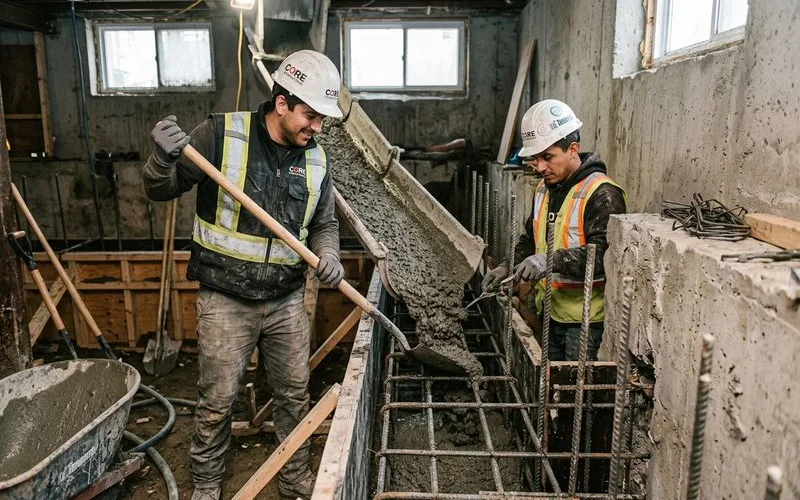
Each pin section is excavated by hand, formed, reinforced, and poured in turn.
Our daily progress depends on weather and curing temperatures, but we typically pour 4 to 6 pin sections per week. The team alternates around the perimeter so no two adjacent footings are left unsupported at the same time. At an average Toronto cost of $50 to $125 per square foot, this methodical excavation is the most labour-intensive part of the job.
The home is heavily monitored throughout the entire digging process.
We install crack gauges on plaster walls upstairs and run daily level checks on main-floor doors.
The structural engineer signs off at multiple inspection points before the city conducts its final pre-pour inspection.
Stage 4: Curing & Waterproofing (2 to 3 weeks)
We require the new mass-concrete footings to cure for 14 to 28 days, depending on ambient temperatures.
Concrete requires a strict minimum of 48 hours of initial curing before anyone can safely move to an adjacent section.
During this broader curing window, the interior waterproofing work happens if it is part of the contract. This critical protection system includes:
- Weeping tile installation in the new perimeter
- Dimpled membrane applied on the inside of the foundation walls
- A sealed sump pit set in the lowest corner to handle future groundwater
The new concrete slab is finally poured to the finished elevation once the perimeter is fully secure.
Stage 5: Final Inspection & Finishing Handoff (1 week)
We arrange the City of Toronto final inspection and secure the engineer’s official sign-off.
If your contract includes basement finishing, the finishing crew takes over the site immediately.
The structural underpinning team demobilizes and cleans the property. The homeowner then receives the engineer’s stamp, the city’s final permit close-out documents, and all warranty paperwork.
Total Project Timeline
If you are wondering how long does underpinning take, a standard structural underpinning job requires an average of 14 to 24 weeks.
This timeframe covers the heavy structural work and curing times. Adding finishing work extends the total duration.
| Stage | Duration |
|---|---|
| Drawings & engineering | 2 to 4 weeks |
| City of Toronto permit review | 4 to 8 weeks |
| Pre-construction setup | 1 to 2 weeks |
| Staged excavation & pin pours | 4 to 6 weeks |
| Curing & waterproofing | 2 to 3 weeks |
| Slab pour, final inspection | 1 week |
| Total (underpinning only) | 14 to 24 weeks |
| Basement finishing (optional, if bundled) | + 6 to 10 weeks |
| Total (underpinning + finishing) | 20 to 34 weeks |
We tell clients to expect a 3.5-to-5-month timeline for the structural phase alone.
A fully finished basement pushes that window to 5 to 8 months.
Anyone promising a completed job in six weeks is either skipping municipal permits or recklessly compressing mandatory curing windows.
Why The Curing Windows Can’t Be Compressed
Concrete chemistry cannot be forced to match a contractor’s hasty schedule.
New mass-concrete footings need to develop their full bearing capacity before the next adjacent pin is poured. The concrete hydration process requires up to 28 days to hit the critical 15MPa strength standard required by code.
Our structural engineers schedule every phase with this exact physics in mind.
Rushing the curing windows is the single most common cause of catastrophic foundation failures. Pins that are poured back-to-back without proper resting time will eventually settle, crack, or shift under the weight of the house.
The project literally takes as long as the chemical hydration takes.
If an estimate shows a suspiciously fast timeline, you must ask exactly which curing phases they are skipping.
Living In The Home During The Project
Most Toronto homeowners choose to stay in the house while the work happens below.
The basement is tightly sealed and dust-isolated with heavy poly walls. Your main-floor utilities, kitchen, and bathrooms will remain in full service.
Our daily on-site hours run from 7:30 AM to 4:30 PM.
The crew sweeps and vacuums the work zone every single afternoon so the upstairs stays perfectly clean.
Exterior excavation phases are quite rare and only happen when adding a brand new separate entrance. These specific exterior tasks might require a short stay-out window due to noise. Otherwise, normal daily life continues upstairs without major interruption.
What Affects The Schedule
We always give realistic schedules in writing during the initial estimate.
If a date slips for any reason, the homeowner is notified immediately.
Several common variables can shift a project timeline:
- Weather constraints: Freezing temperatures extend concrete curing windows, while heavy rain delays any open-trench phases.
- Permit hurdles: Living in a Heritage Conservation District or needing Committee of Adjustment approval adds months to the wait.
- Project scope: Digging out a partial basement is faster than a full perimeter, and pursuing an extreme depth gain takes much longer.
- Crew availability: Spring remains the busiest construction season in Ontario, so booking early is essential.
- Soil conditions: Hitting wet clay or unexpected underground obstructions will add days to the excavation phase.
Budget directly shapes which schedule is realistic for your home. See our Ontario underpinning cost guide for the per-linear-foot ranges driving each scope tier.
Ready To Book A Site Visit?
We strongly recommend starting with an engineered assessment to understand your property’s true potential.
You can Request a free estimate directly through our site. A team member typically responds within two business hours to get you on the schedule.
This initial visit will clarify your exact basement underpinning process and set clear expectations.